
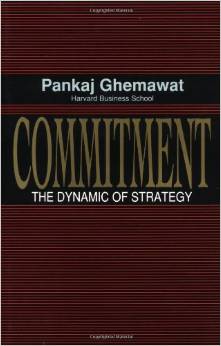
GHEMAWAT P., Commitment. The dynamic of strategy. Free Press, 1991
[one_half]
 [/one_half]
[one_half_last]
CONTENTS
Chapter 1 – Strategy: the failure of success factors
1.1. Strategy Has come to focus on success factors
1.2. Success factors are a shaky foundation for strategy
1.3. The failure of success factors isn’t fatal to the enterprise of strategy
Chapter 2 – Commitment: the persistence of strategies
2.1. I define commitment as the tendency of strategies to persist over time
2.2. Commitment is crucial to explain strategic dynamics[/one_half_last]
2.3. Commitment is caused by Lock-in, Lock-out, Lags and inertia
2.4. Commitment is the only general explanation for sustained
2.5. Differences in the performance of organizations
2.6. The irreversibility implicit in commitment necessitates a deep Lock into the future
Chapter 3 – Choice: making commitments
3.1. Commitment complicates choice
3.2. Orthodox approaches to choice do not help managers cope with commitment
3.3. Commitment is mostly concentrated in a few choices
3.4. Attention shoul be focused on commitment-intensive (strategic) choices
3.5. Strategic choices demand cost-benefit analysis
3.6. The cost-benefit analysis of strategic choices can partly be systemized
Chapter 4 – Positioning: creating value
4.1. Reconsider the launch of the Lockeed Tristar
4.2. Positioning analysis compares the costs incurred and the benefits delivered by strategic options
4.3. Positioning analysis can usefully be reillustrated
4.4. Positioning analysis is an incomplete basis for strategic choice
Chapter 5 – Sustainability: claiming value
5.1. Sustainability analysis is very important
5.2. The sustainability of superior product markket positions hinges on comitment to sticky factors
5.3. Imitation is a direct threat to the scarsity value of sticky factors
5.4. Substitution in an indirect threat to the scarsity value of sticky factors
5.5. Holdup threatens to divert scarcity value
5.6. Slack threatens to dissipate scarcity value
5.7. Sustainability analysis should be integrated with positioning analysis
Chapter 6 – Flexibility: the value of recourse
6.1. Reconsider the replacement of old coke with new coke
6.2. Revisions tend to be common
6.3. Revision possibilities afford flexibility value
6.4. Flexibility analysis should be integrated with positioning and sustainability analysis
6.5. The integration procedure can be illustrated
6.6. Flexibility is particularly valuable in the presence of ambiguity and learning possibilities
Chapter 7 – Judgment: Coping with error
7.1. Errors in the analysis may be either honest mistakes or deliberate distortions
7.2. Considr bidding patterns on offshore Oil and Gas analysis
7.3. The analysis should be supplemented with experience
7.4. Experience should not be overemphasized
7.5. Organizations confront trade-offs between errors and errors of commissions
7.6. Different organizational arrangements tend so lead to different mixes and errors


Scrivi un commento
Devi accedere, per commentare.